Key-Value Stores
The key-value store is the simplest database model there is — and one of the most used: almost every larger web application has one, usually as a cache or session store. This scriptum answers:
- How does a key-value store work?
- Redis or Valkey — what happened there?
- Which data types and commands are the most important?
- How consistent and how scalable is it?
- How do we classify it?
1. The idea: one big hash table
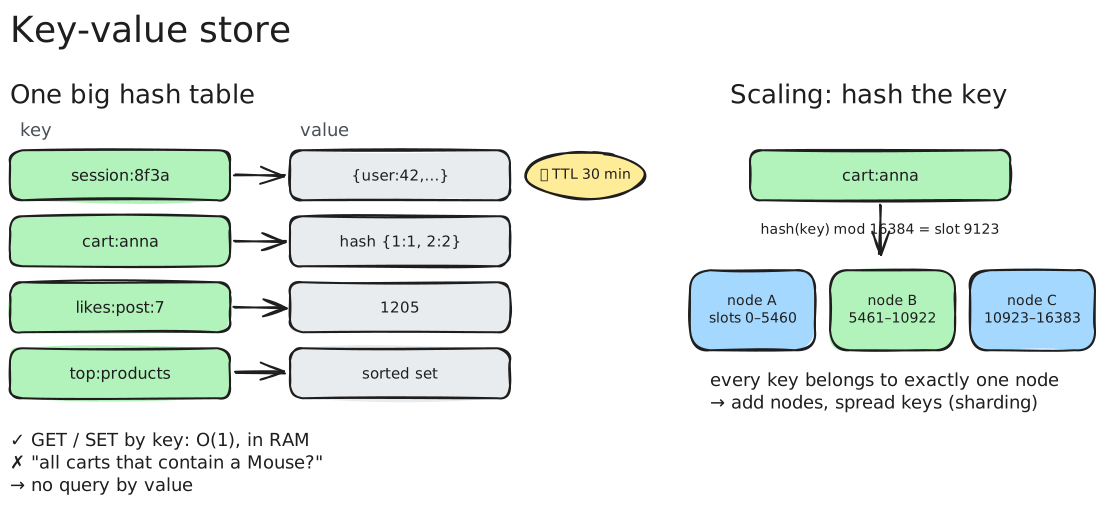
- Every entry is a pair: key → value.
- The key is a string, unique in the whole database.
- The value is (for the database) a black box — it cannot search inside it.
- Only three basic operations:
SET key value,GET key,DEL key. - Lookup by key is O(1) — no matter if there are 10 or 10 million keys.
- Usually kept in RAM → answers in well under a millisecond.
The price of this speed: you can only find data by its key. “Give me all carts that contain a Mouse” is impossible without reading every cart.
2. Redis or Valkey?
Redis (2009) was the open-source key-value store for 15 years. Then:
| When | What happened |
|---|---|
| March 2024 | Redis Ltd. changes the licence from open-source BSD to source-available licences (RSALv2/SSPL), starting with Redis 7.4. Cloud providers may no longer offer it freely. |
| days later | The Linux Foundation forks the last open version (7.2.4) as Valkey — backed by AWS, Google, Oracle and others. BSD licence. |
| May 2025 | Redis 8 adds the AGPLv3 — open source again, but with strict obligations. |
| 2025/26 | Many Linux distributions (Fedora, Ubuntu, Arch) ship Valkey by default; all big clouds offer managed Valkey. |
What this means for you:
- Valkey and Redis speak the same protocol and the same commands. Everything in this scriptum works on both.
redis-clican talk to Valkey andvalkey-clito Redis; most client libraries (e.g. StackExchange.Redis for C#) work with both.- We use Valkey in class: BSD licence, no strings attached.
The same story happened before: MongoDB switched to the SSPL licence in 2018, Elasticsearch in 2021 (→ fork OpenSearch). Licences matter when you build a product on top of a database.
3. Data types and commands
Valkey is more than “string → string”. The value can have one of several types:
| Type | Think of it as | Important commands | Typical use |
|---|---|---|---|
| String | a single value (text, number, binary) | SET, GET, INCR, DECR | cache entries, counters |
| Hash | a small object: field → value | HSET, HGET, HGETALL, HINCRBY, HDEL | shopping cart, user profile |
| List | ordered list (queue) | LPUSH, RPUSH, LPOP, LRANGE, LTRIM | ”last viewed products”, job queues |
| Set | unordered, no duplicates | SADD, SMEMBERS, SISMEMBER, SINTER | tags, “who liked this” |
| Sorted set | set with a score, sorted by score | ZADD, ZINCRBY, ZREVRANGE | leaderboards, top-10 products |
3.1 Expiry: TTL
Every key can get a time to live. When it expires, the key deletes itself.
SET session:8f3a "user:42" EX 1800    # lives for 30 minutes
TTL session:8f3a                      # → 1799 (seconds left)
EXPIRE cart:anna 86400                # cart disappears after one day
This is why key-value stores are the standard for sessions and caches.
3.2 Key design
Because keys are the only way to find data, their names are your “schema”. Convention: object-type:id :field, separated by colons.
user:42                → hash with name, email, …
user:42:cart           → hash productId → quantity
product:7:views        → counter
session:8f3a           → string with TTL
top:products           → sorted set
Designing keys and values for real use cases is a topic of its own — we will come back to it in a later block.
4. Consistency and durability
4.1 Every command is atomic
Valkey executes commands one after another (single-threaded command execution). So INCR can never produce a lost update — remember the stock problem from Exercise_Transactions_Isolation:
Client A: INCR likes:post:7   → 1204
Client B: INCR likes:post:7   → 1205    ✓ no update lost
For several commands as one unit there is MULTI … EXEC (all commands run together, nothing in between — but no rollback if one of them fails).
4.2 RAM is volatile — persistence
| Mode | How it works | Risk |
|---|---|---|
| none | pure cache | everything lost on restart |
| RDB snapshots | the whole dataset is written to disk every few minutes | changes since the last snapshot are lost on a crash |
| AOF (append-only file) | every write command is appended to a log file | slower; with fsync every second at most ~1 s is lost |
Durability (“D” in ACID) is therefore configurable — and by default weaker than in MySQL.
4.3 CAP
- Replication primary → replicas is asynchronous: a confirmed write can be lost if the primary crashes before replicating. Reads from replicas can be stale.
- → Valkey/Redis behave AP-like (availability and speed first).
- Exception: etcd (the key-value store behind Kubernetes) uses the Raft consensus protocol and is strictly CP.
- DynamoDB (Amazon) lets you choose per read: eventually consistent or strongly consistent.
5. Scaling: hash the key
- Cluster mode splits the key space into 16 384 hash slots:
slot = CRC16(key) mod 16384. - Every node is responsible for a range of slots → every key lives on exactly one node (Z-axis, sharding).
- Add a node → move some slots to it.
- Because every request only touches one key, there is no cross-node JOIN — scaling out is easy.
6. Classification: key-value stores
| Criterion | Key-value |
|---|---|
| Data model | key → value (value opaque; in Valkey: string, hash, list, set, sorted set) |
| Schema | none — the key naming convention is the “schema” |
| Query language | simple commands (GET, SET, …), access only by key |
| Relationships | none — at most a key name stored inside a value |
| Transactions | each command atomic; MULTI/EXEC without rollback |
| CAP (default) | AP (async replication); etcd is CP |
| Scaling | horizontal by hashing keys (hash slots) |
| Strengths | extremely fast (RAM, O(1)), simple, TTL, atomic counters |
| Weaknesses | no queries by value, no relationships, data size limited by RAM, weaker durability |
| Typical use | cache, sessions, shopping carts, counters, rate limiting, leaderboards, queues |
| Examples | Valkey, Redis, Memcached, DynamoDB, etcd |
7. Summary
- A key-value store is a giant hash table: lightning-fast access by key, nothing else.
- Valkey is the BSD-licensed fork of Redis; both use the same commands.
- Values can be strings, hashes, lists, sets and sorted sets; every key can have a TTL.
- Every command is atomic (single-threaded execution); durability depends on RDB/AOF.
- Default behaviour is AP; scaling out works by hashing the key to a slot.
8. Self-check questions
- Why is a lookup in a key-value store O(1)?
- Why can’t a key-value store answer “all carts containing product 7”?
- What is Valkey, and why does it exist?
- Which data type would you use for (a) a shopping cart, (b) a top-10 product list, (c) the last 5 viewed products?
- What happens to a key with
EX 60after one minute? - Why is
INCRsafe against lost updates? - Your server crashes. Which data is lost with RDB snapshots, which with AOF (fsync every second)?
- Why are Valkey/Redis classified as AP?
- How does Valkey cluster decide on which node a key is stored?
- Name three typical use cases for a key-value store.
Short answers
- The key is hashed directly to its storage position — no searching through other entries.
- The values are black boxes and can only be found by their key; the store would have to read every single cart.
- A fork of Redis 7.2.4 by the Linux Foundation, created in 2024 after Redis left its open-source BSD licence. Valkey stays BSD-licensed.
- (a) hash, (b) sorted set, (c) list (
LPUSH+LTRIM). - It is deleted automatically.
- Commands run one after another, so read-increment-write happens inside the server as one step.
- RDB: everything since the last snapshot (minutes). AOF: at most about one second.
- Replication is asynchronous: the primary answers immediately, replicas may be behind and a confirmed write can be lost on failover.
CRC16(key) mod 16384gives the hash slot; each node owns a range of slots.- e.g. sessions, caching, counters, shopping carts, leaderboards, rate limiting.