API
| A | Application |
| P | Programming |
| I | Interface |
An API is an interface that allows other programs to use functionality or data that you expose — without knowing how it is implemented.
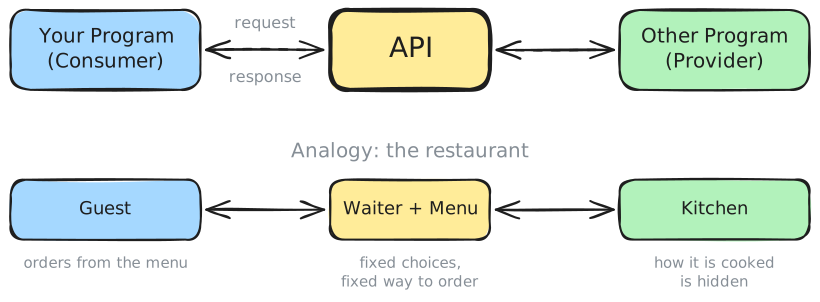
In terms of distributed systems, an “API” usually means a Web API: an interface that is used over a network.
API use cases
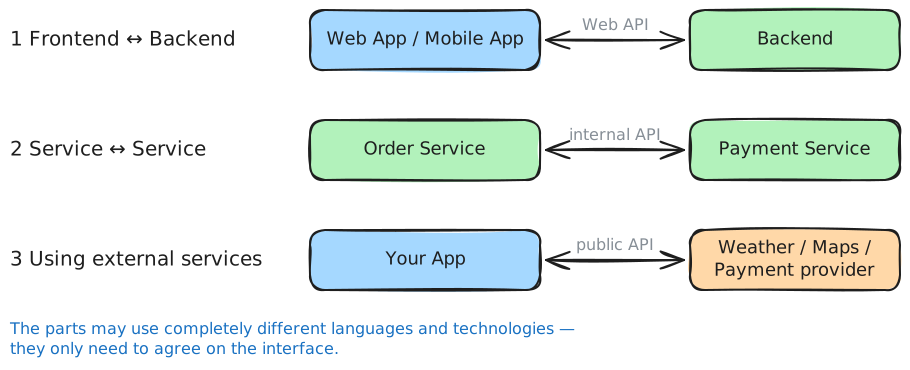
- Frontend ↔ Backend – your web or mobile app loads and stores data on the server.
- Service ↔ Service – components of a distributed system talk to each other.
- External services – weather, maps, payment, login, AI … (Data as a Service).
Software parts written in different languages can work together — as long as they agree on the same interface and the same protocol.
Example: weather data
Request:
GET https://www.7timer.info/bin/astro.php?lon=15.593063&lat=48.411018&ac=0&unit=metric&output=jsonResponse:
HTTP/1.1 200 OK
Content-Type: application/json

{
  "product": "civil",
  "init": "2023070206",
  "dataseries": [
    { "cloudcover": 7, "temp2m": 21, "rh2m": "63%",
      "wind10m": { "direction": "W", "speed": 3 } },
    ...
  ]
}
Try it: paste the URL into your browser or run curl -i "<url>".
Many words – what is what?
“It’s a REST API that uses HTTP and JSON, described with OpenAPI.” These words are not alternatives — they describe different layers:
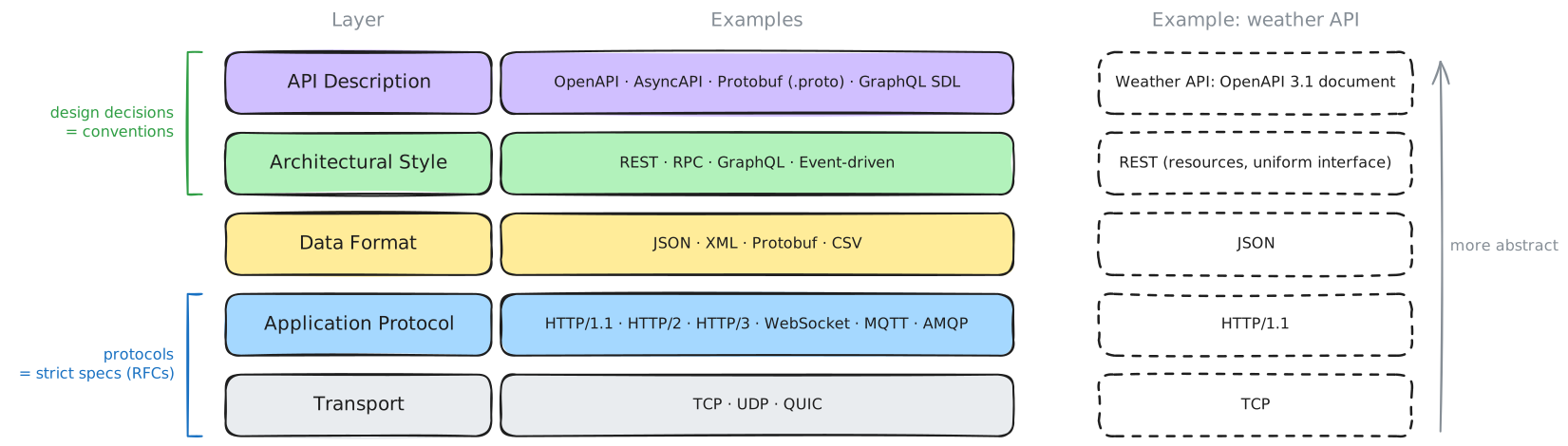
| Layer | Question | Examples |
|---|---|---|
| API description | How is the API documented? | OpenAPI, AsyncAPI, .proto |
| Architectural style | How is the API designed? | REST, RPC, GraphQL, event-driven |
| Data format | How is the content encoded? | JSON, XML, Protobuf |
| Application protocol | Which messages are exchanged? | HTTP, WebSocket, MQTT |
| Transport | How do the bytes get there? | TCP, UDP, QUIC |
Protocol vs. architectural style
Protocols …
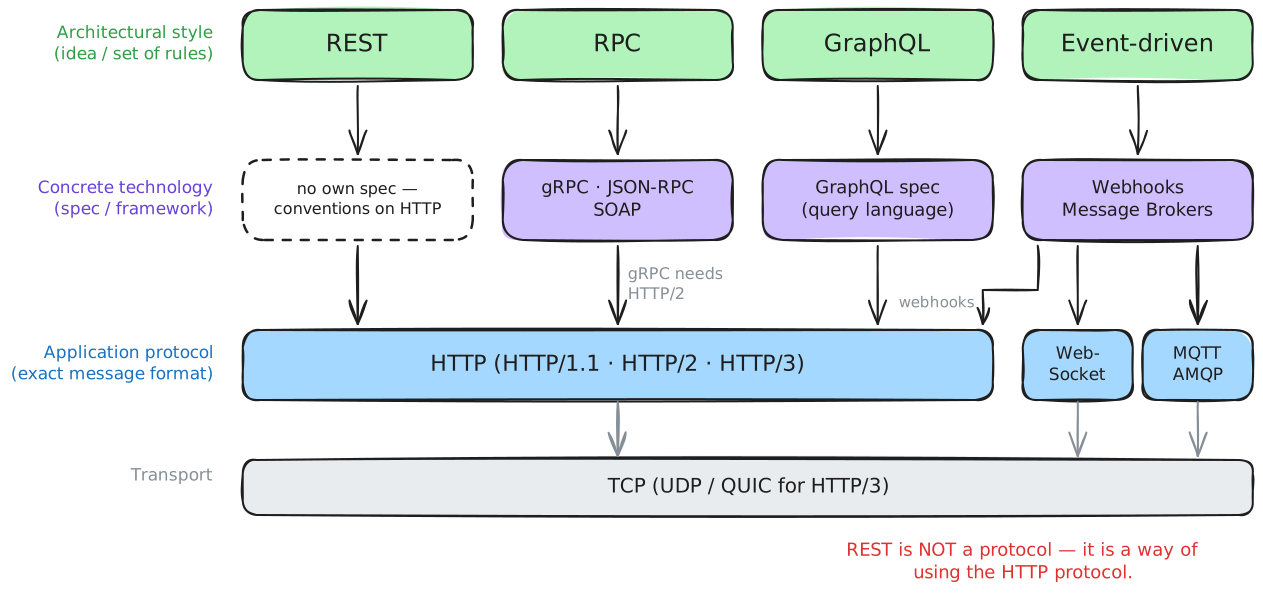
- define exactly how two processes exchange messages (format, meaning, order).
- work between processes on different machines over a network.
- are open to any technology or programming language.
- have a clear, written specification (e.g. an RFC).
Architectural styles …
- are design rules / ideas for building an API on top of a protocol.
- have no strict specification — you can follow them more or less well.
| Protocol | Architectural style | |
|---|---|---|
| Examples | HTTP, WebSocket, MQTT | REST, RPC, event-driven |
| Violate it? | it doesn’t work | it works, but it’s not that style |
| Analogy | grammar of a language | writing style (letter, poem, news) |
🔑 REST is not a protocol — it is a way of designing an API that uses the HTTP protocol.
Ways of providing an API
REST
- Architectural style (Roy Fielding, 2000) — built on HTTP.
- Everything is a resource with its own URL; you use HTTP methods on it.
GET    /students/42
DELETE /students/42- Use: the default for most web APIs — simple, widely supported, cacheable.
GraphQL
- Query language for APIs (Facebook, 2015) — usually one endpoint over HTTP.
- The client decides which fields it wants.
{ student(id: 42) { name grades { subject value } } }- Use: frontends that need flexible data from many sources in one request.
gRPC
- RPC framework (Google, 2015) — call functions on a remote server like local ones.
- Contract in a
.protofile, binary Protobuf messages over HTTP/2. - Use: fast, strongly typed communication between services (microservices).
SOAP
- XML-based messaging protocol (W3C), usually over HTTP; described with WSDL.
- Use: older enterprise and government systems (banks, insurance) — you will still meet it.
WebSocket
- Protocol for a permanently open, bidirectional connection (starts as HTTP).
- Use: real-time data — chat, live scores, multiplayer games, dashboards.
Webhooks
- A pattern, not a protocol: the provider sends an HTTP POST to your URL when something happens.
- Use: notifications — “payment received”, “new commit pushed”.
Message brokers (MQTT, AMQP, Kafka)
- Publish/subscribe: senders publish to a topic, receivers subscribe (→ Distributed-Systems).
- Use: IoT (MQTT), decoupled background processing, event streaming.
MCP – Model Context Protocol
- Open protocol (Anthropic, 2024) based on JSON-RPC.
- Lets AI applications (e.g. Claude, ChatGPT, IDE assistants) connect to external tools and data in a standardised way.
- An MCP server exposes tools, resources and prompts; the AI app is the client.
- Use: give an AI model access to your files, databases or APIs — “a USB-C port for AI”.
Overview
| Name | What is it? | Runs on | Format | Typical use |
|---|---|---|---|---|
| REST | architectural style | HTTP | mostly JSON | web APIs |
| GraphQL | query language + spec | HTTP | JSON | flexible frontends |
| gRPC | RPC framework / protocol | HTTP/2 | Protobuf | service ↔ service |
| SOAP | messaging protocol | HTTP | XML | legacy enterprise |
| WebSocket | protocol | TCP | text / binary | real-time |
| Webhooks | pattern | HTTP | mostly JSON | event notifications |
| MQTT / AMQP | protocols (pub/sub) | TCP | any | IoT, messaging |
| MCP | protocol | JSON-RPC over stdio / HTTP | JSON | AI ↔ tools |
Usage
From the Postman State of the API Report 2025:

Summary
- An API is an interface for programs; a Web API is used over the network.
- Keep the layers apart: transport → protocol → data format → style → description.
- Protocols (HTTP, WebSocket, MQTT, MCP …) are strict message specifications.
- Architectural styles (REST, RPC, event-driven …) are design ideas on top of protocols.
- REST, GraphQL and gRPC all usually travel over HTTP — they differ in design.
Check your understanding
- Explain the difference between a protocol and an architectural style. Give two examples of each.
- What is wrong with the sentence “Our API uses REST instead of HTTP”?
- Assign each term to its layer:
TCP,REST,JSON,HTTP/2,OpenAPI,Protobuf,MQTT,QUIC. - Which technology would you choose — and why?
- a chat app that shows new messages instantly
- 50 internal microservices that call each other thousands of times per second
- temperature sensors in every classroom
- an AI assistant that should be able to read your school’s timetable